Sony Classical
George Szell - Beethoven:Symphony No.1-9 / Overtures - Import7 CDBox SetLimited Edition
George Szell - Beethoven:Symphony No.1-9 / Overtures - Import7 CDBox SetLimited Edition
CD
Classical Music
Symphony
13 de diciembre de 2024
Will usually ship within 1~5 business days of receiving cleared payment.
No se pudo cargar la disponibilidad de retiro
Catalog No.: 19802819962
JAN/ISBN: 198028199629
Number of Discs: 7
Country/Region of Manufacture: Import
Credits:
George Szell
Description:
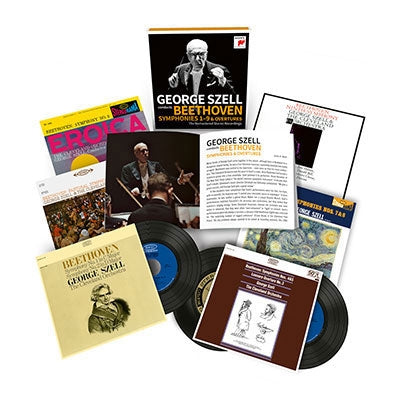
Beethoven: The Soul of the World Contents. [CD1] Symphony No. 1 in C major, Op. 21 [Recorded at Severance Hall, Cleveland, October 2, 1964 Symphony No. 2 in D major, Op. 36 [Recorded at Severance Hall, Cleveland, October 23, 1964 [CD2] Symphony No. 3 in E flat major, Op. 55 "Hero CD3] Symphony No. 3 in E-flat major, Op. 55 "Hero" [Recorded: February 22-23, 1957, Masonic Temple Auditorium, Cleveland [CD3] Symphony No. 4 in B flat major, Op. 60 Overture to "Leonore" No.3, Op.73b [Recorded at Severance Hall, Cleveland, April 5-6, 1963. Symphony No.5 in C minor, Op.67 [Recorded at Severance Hall, Cleveland, October 11 & 25, 1963 [CD4] Symphony No. 6 in F major, Op. 68 "The Countryside [Recorded at Severance Hall, Cleveland, January 20-21, 1962 [CD5] Symphony No. 7 in A major, Op. 92 [Recorded: October 30-31, 1959, Severance Hall, Cleveland. Symphony No. 8 in F major, Op. 93 [Recorded at Severance Hall, Cleveland, April 15, 1961 [CD6] Symphony No. 9 in D minor, Op. 125 "Chorus [Adele Addison (soprano), Jane Hobson (mezzo-soprano) Richard Lewis (tenor), Donald Bell (baritone) Cleveland Orchestra Chorus (Chorus Conductor: Robert Shaw) [Recorded at Severance Hall, Cleveland, April 15, 21, 22, 1961 [CD7] Overture to "Egmont", Op.84 [Recorded at Severance Hall, Cleveland, October 8, 1966. Overture to "Coriolan", Op.62 [Recorded at Severance Hall, Cleveland, October 29, 1966 Overture to "King Stefan", Op.117 [Recorded at Severance Hall, Cleveland, October 29, 1966 Overture to "Leonore" No.2, Op.72b [Recorded at Severance Hall, Cleveland, October 8, 1966 Overture to "Leonore" No.1, Op.138 [Recorded at EMI Studios, London, August 25, 1967 Overture to "Fidelio," Op.72b [Recording] August 25, 1967, EMI Studios, London Performers George Szell, conductor Cleveland Orchestra ■Specifications Each disc is enclosed in the paper jacket of the first US LP (both front and back jackets reproduce the design of the first LP). Disc label design: original design of the original release 20-page, all-color booklet with track listings for all discs (including detailed recording data such as matrix numbers, first-issue catalog numbers, etc.) Liner notes by James H. North Each disc and booklet are enclosed in a cardboard clamshell box. This album is a comprehensive boxed set of stereo recordings of Beethoven's symphonies and orchestral works by Schoj Sell and the Cleveland Orchestra. This is the first international boxed release in 11 years, since the 2004 No Original Jacket Collection and the 2013 MASTERS Series release. The complete Beethoven symphonies by this duo are representative of their vast Columbia recordings, and are a precious recording of a world heritage of music that has long been heard as the standard Beethoven complete works of the analog stereo era. The tight, unambiguous performance design, with its muscular sound and strong driving force, and the way the individual voices of the orchestra are reproduced without strain and with astonishing clarity, is the result of Cell's good ear and the extremely high performance ability of the Cleveland Orchestra, which is truly a masterpiece of 20th century orchestral art along with the Karajan/Berlin Philharmonic, the Ormandy/Philadelphia, and others. The result is a masterpiece of 20th century orchestral artistry on par with the Karajan/Berlin Philharmonic and Ormandy/Philadelphia orchestras. The aggressive orchestral revisions in various parts sound fresh to today's ears, where the original performance is taken for granted, and the adoption or non-adoption of repeats shows Cell's keen eye for detail. The nine symphonies were recorded over a period of almost seven years, beginning with No. 3 "Hero" in February 1957 and ending with Nos. 1 and 2 in October 1964, and released on the Epic label. Since the Epic label was a subsidiary of Columbia, the recording itself was handled by Columbia staff, with Howard H. Scott (also known as Glenn Gould's first producer) in the 1950s and Paul Myers in the 1960s. In the 1960s, Paul Myers was the main producer. In the 1950s, Howard H. Scott (also known as Glenn Gould's first producer) and Paul Meyers were the main producers. The result was a wide left-right spread, dense, and crisp stereo recording. It was recorded using the best stereo and 3-track technology of its time, along with "Living Stereo" promoted by RCA, another major U.S. recording company.The seven overtures were recorded in 1966 and 1967, after the recording of the complete symphonies was completed, except for Leonore No. 3, which was recorded in April 1963 and released in the same year in coupling with Symphony No. 4, and this one was released on the Columbia label from the beginning. With the exception of Symphony No. 3 and two overtures, the recordings were made at Severance Hall, the former home of the Cleveland Orchestra. Completed in 1929 and inaugurated in 1931, the 1844-seat auditorium has been called "America's most beautiful concert hall" for its Greek Neoclassical exterior and elegant Art Deco-inspired interior. The hall is also an excellent recording venue, as it is not overly resonant, yet it is capable of capturing the full transparency and clarity of the cell's distinctive sound. What is unusual is that "Fidelio" and "Leonore No. 1" were recorded at EMI Studios (Abbey Road Studios) in London during a European tour in the summer of 1967. It would be interesting to compare the sound quality. The box will be reissued in its original LP paper-jacketed format, using the DSD remastering of the 2018 "George Sell - Complete Album Collection," remixed and remastered from the original analog masters by the master musician Andreas Meyer. From the international edition liner notes. This album reveals a multifaceted portrait of George Sell. He was born in Budapest to a Hungarian Jewish family, but he was a true Viennese musician, extremely gifted, and arrogant to the point of coarseness. Beethoven was central to his repertoire, more so than many other conductors. The Cleveland Orchestra was a brilliant jewel that Sell polished. Artur Rodzinski had turned a lowly regional orchestra under his direction into a superb ensemble, and Sell had polished it. Donald Hennahan of The New York Times praised the Cleveland Orchestra as "the most perceptive orchestra in the world. One day, ten years after Sell's death, Cleveland's music director, Christoph von Dohnányi, lamented, --- "We give great concerts, but it is George Sell who gets the credit. . Some criticized Sell's playing as being too fast, too stiff, and lacking warmth, to which he responded, "You can't put chocolate sauce on asparagus," he declared. He was a rigorous conductor, in contrast to Bruno Walter and Charles Müncht. Sell and the Cleveland Orchestra played with a precision and sense of style that rivaled Toscanini's, but they did not have the singing string sound that Toscanini excelled at.Some Cleveland Orchestra members felt that the concert was "too rehearsed" and "too tight" and that the rehearsals were superior performances. But any problems were always resolved in the recording sessions, and even in this Beethoven recording, there are no wrong notes, ambiguous cues, out-of-tune moments, or awkward phrases. Sell felt that Columbia favored the Ormandy-Philadelphia Orchestra and the Mitropoulos-New York Philharmonic in terms of recording, while neglecting himself and the Cleveland Orchestra. One of the reasons for this is that Sell's recording repertoire consisted of German and Austrian music of the 18th~19th centuries, and he did not willingly record French music or 20th century music. In addition, the Cleveland Orchestra always had a tight budget and low salaries for its orchestra members. During Lodzinski's time, the orchestra had about 80 members, with half the size of the string section. Sell succeeded in increasing that number to 100. Nevertheless, the Sell era was riddled with managerial problems, and there were constant feuds between Sell, the orchestra members, the trade union, the management, and the board of directors. However, there is no hint of such backstage troubles in this flawless performance of Beethoven. (Extracted from the liner notes by James H. North on this disc/booklet in English only) (Sony Music)
Shipping & Returns
Shipping & Returns
**Shipping Carriers**
We ship all orders via **Japan Post**, **DHL**, or **FedEx**, depending on the destination and shipping method selected at checkout.
---
**Delivery Time**
- **In-stock items**: Orders are processed and shipped within **51 to 5 business days or 5 to 30 business days** from the date of purchase.
- **Pre-orders**: Items will be shipped within **7 business days** after the official release date.
- **Special order items**: Delivery may be delayed depending on the supplier's stock status. We will contact you if delays exceed the estimated timeframe.
Please note: Delivery times may vary due to customs clearance, weather conditions, postal delays, and holidays. Thank you for your understanding.
---
**Shipping Costs**
Shipping costs are calculated automatically at checkout using our shipping rate calculator. Final shipping charges depend on your destination and the total weight of your order.
We currently offer **international shipping** to most countries.
---
**Returnsv**
We have a 30-day return policy, which means you have 30 days after receiving your item to request a return.
To be eligible for a return, the product must be unused, unopened (i.e., shrink wrap or manufacturer seal must be intact), and in the same condition as when you received it, including the original packaging.
Customers are responsible for return shipping costs unless the return is due to our error (e.g., defective, damaged, or incorrect item). Please note that we are unable to refund the original shipping charges.
To initiate a return, please contact us at ruryaam@gmail.com. If your return is accepted, we’ll provide you with a return shipping label and detailed instructions. Items sent back to us without first requesting a return will not be accepted.
You can always contact us for any return-related questions at ruryaam@gmail.com.
---
**Damages and Issues**
Please inspect your order upon delivery and contact us immediately if the item is defective, damaged, or incorrect. We will work quickly to resolve the issue.
Return Address: Rury Art & Music Inc., 2-3-3 Minamikoiwa, Edogawa-ku, Tokyo, Japan 133-0056
(Please contact us before sending any items.)
---
**Non-returnable Items**
Unfortunately, we cannot accept returns for items on sale or gift cards.
---
**Exchanges**
To exchange an item, we recommend returning the original item and placing a new order separately after the return is accepted.
---
**Refunds**
Once we receive and inspect your returned item, we will notify you of the approval status. If approved, your refund will be processed to your original payment method within 5–10 business days. Please note that your bank or credit card provider may take additional time to post the refund to your account.